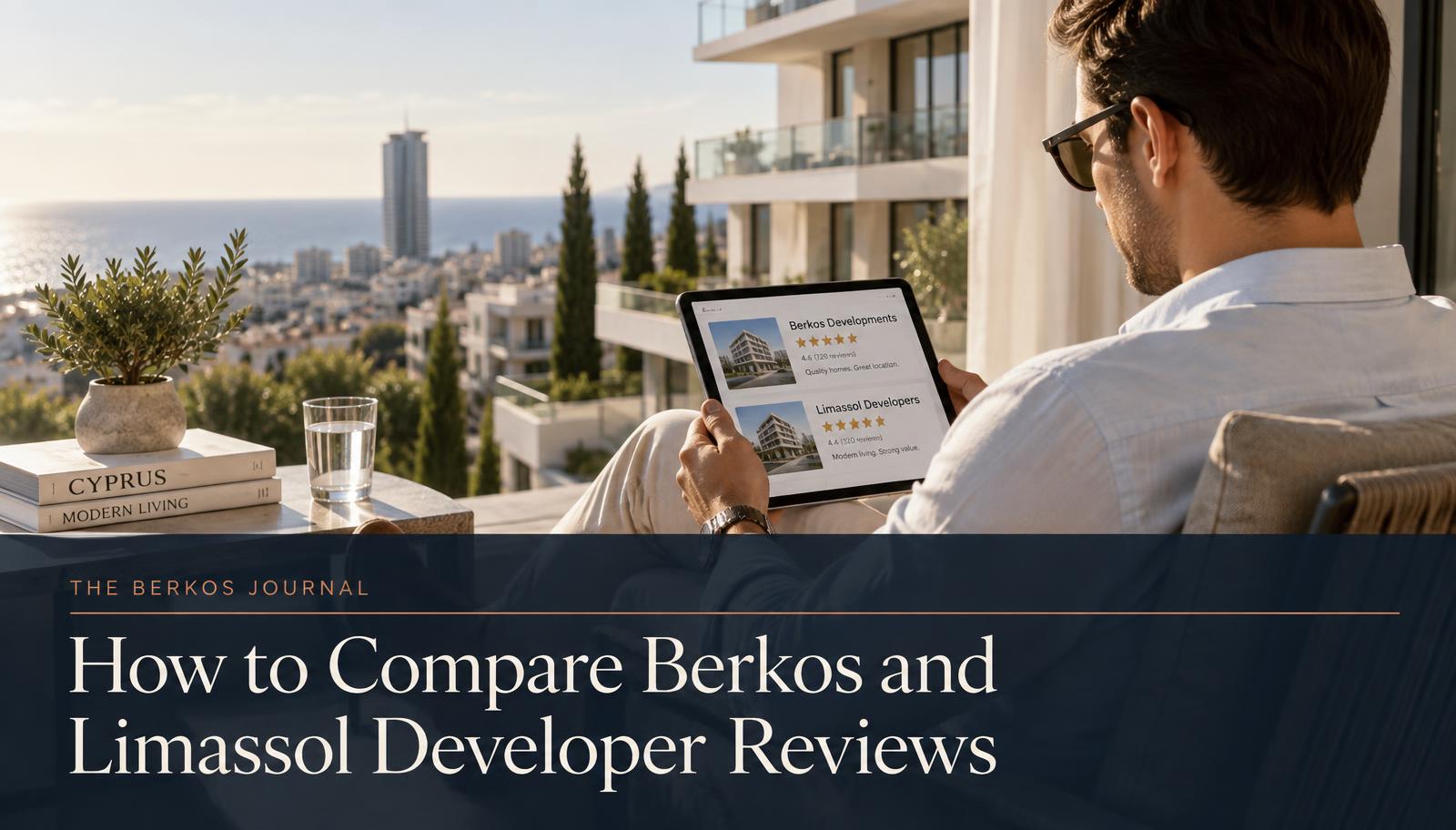
Berkos reviews cannot be compared fairly with reviews of other established Limassol developers by looking at star ratings alone. A useful comparison must use the same sources and period, distinguish between project and transaction stages, identify recurring themes and test important claims against documents, completed work and the developer’s response.
Without a defined review dataset, it would be misleading to claim that Berkos is rated better or worse than another developer. The practical approach is to use reviews as evidence leads: they show buyers what to investigate, but they do not complete the investigation.
Start with the same review sample
Comparisons become unreliable when one developer is assessed through recent public reviews while another is judged through selected testimonials or comments collected over many years.
Choose the public sources to review, set the same date range and record the number of relevant comments found for each developer. Keep website testimonials separate from independent public platforms because they are selected and presented differently.
Do not combine developers with very different review volumes into a single ranking without explaining that limitation. A small number of detailed reviews may reveal useful questions, but it does not create a statistically reliable league table.
Separate each stage of the buyer experience
A property purchase has several stages, and performance at one stage does not prove performance at another. Classify each relevant review before drawing conclusions:
- Enquiry and sales: responsiveness, clarity and accuracy of initial information.
- Reservation and contract: written terms, document availability and communication.
- Construction: updates, changes, selections and access to information.
- Inspection and handover: snagging, corrections, keys and documents.
- After-sales: reporting, response process and any separately agreed service.
A positive comment after a sales meeting cannot establish construction quality. Likewise, a handover complaint may be relevant to buyers, but its context and resolution still need to be understood.
Check whether the review is specific
More useful reviews identify the project, approximate stage and issue being described. General statements such as “excellent developer” or “avoid this company” provide little information unless the reviewer explains the experience behind the conclusion.
Look for details that could reasonably be checked: which document was requested, what changed, when the question arose and how the developer responded. Avoid treating an anonymous assertion as a verified fact simply because it appears in a public forum.
Look for patterns, not extremes
One unusually positive or negative review can dominate perception. A fair comparison gives more weight to themes that recur across independent comments.
Useful themes may include:
- Clarity of plans, specifications and inclusions.
- Consistency and usefulness of progress updates.
- How changes or substitutions were communicated.
- Inspection, snagging and correction procedures.
- Availability of documents at handover.
- The scope and responsiveness of after-sales support.
Repeated themes deserve further investigation. They are still questions to verify, not automatic proof that every project or buyer will have the same experience.
Connect review claims to evidence
If a review praises or criticises construction quality, ask which part of the property it concerns and whether a qualified professional inspected it. If it discusses plans, specifications, timing or included items, compare the claim with the relevant documents for that transaction.
Where appropriate, visit a comparable completed development. Consider its age, property type and maintenance before using it as evidence for a current project. An independent technical adviser can help distinguish visible observations from matters requiring drawings, tests or specialist investigation.
Evaluate the developer’s response
A response does not automatically prove that the developer or reviewer is correct. It does, however, show how the company handles a public concern.
Look for a response that addresses the specific issue, distinguishes confirmed facts from disputed points and explains the next step. Generic praise, defensive language or a request to continue privately may not provide enough information to assess the substance.
For a material concern, ask the developer directly and request the relevant project-specific evidence where it can properly be shared.
Compare Berkos using the same standard
Berkos should be assessed with the same framework applied to every other shortlisted Limassol developer. Buyers can request the available plans, written specification, confirmed inclusions, price information and project-stage documents for the exact unit being considered.
When a public review raises a relevant issue, ask whether it concerns the same project type and stage. Then compare the comment with the documents, completed work and written process applicable to the proposed purchase.
This avoids two opposite errors: accepting favourable Berkos comments as proof without verification, or treating an isolated negative comment as representative of every Berkos property.
Developer review comparison scorecard
| Area | What to compare | Limitation to record |
|---|---|---|
| Sources | Same public platforms and date range | Selected testimonials kept separate |
| Projects | Named and comparable developments | Different age, scale or property type |
| Stages | Sales, construction, handover and after-sales | Review may cover only one stage |
| Themes | Issues repeated across independent reviews | Small or uneven sample |
| Evidence | Plans, specifications, records and completed work | Some documents may be private |
| Response | Specific answer and stated next step | Response may not resolve disputed facts |
Questions to ask after reading reviews
- Which project and transaction stage does this review describe?
- Is the property comparable with the one I am considering?
- Does the reviewer describe a first-hand experience?
- Does the same theme appear across independent sources?
- Which document or completed project could help verify the claim?
- How did the developer respond to the issue?
- What remains uncertain or unavailable?
- Which points require independent legal or technical advice?
Conclusion
A fair comparison of Berkos and other Limassol developer reviews does not begin with deciding which company wins. It begins by making the evidence comparable.
Use the same sources and period, separate each transaction stage, investigate recurring themes and verify material claims against project-specific evidence. Reviews are most valuable when they lead to better questions and better due diligence.
BERKOS Team
BERKOS is an integrated real estate group in Limassol, Cyprus, covering development, construction, property management and the legal and financial work around them.