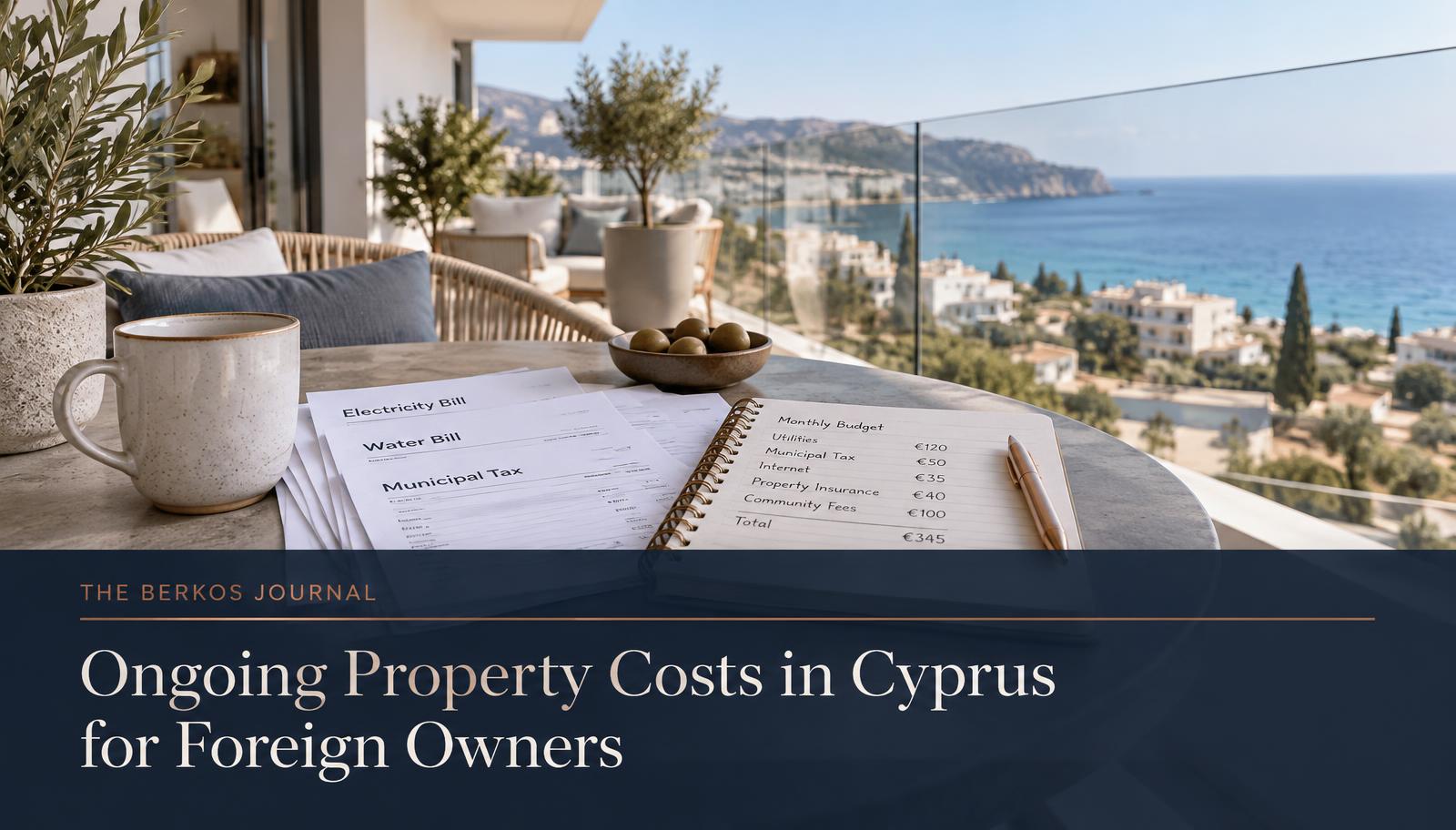
Ongoing property costs in Cyprus usually include common expenses, local and district charges, utilities, insurance, maintenance and any management services the owner chooses or requires. If the property produces rental income, tax compliance and professional fees may also form part of the annual budget.
There is no reliable universal annual figure for every foreign owner. Costs depend on the exact property, location, shared facilities, consumption, financing, occupancy and intended use. The safest approach is to build a property-specific schedule from current bills, written budgets and quotations.
Separate purchase costs from ongoing ownership costs
Start by separating one-time transaction costs from expenses that continue after completion. Purchase-related VAT, transfer charges, stamp duty, legal work, valuations and mortgage setup are not the same as the recurring cost of holding and operating the property.
An ownership budget should show each recurring item, how often it is paid, who pays it and where the estimate came from. This distinction makes properties easier to compare and reduces the risk of mixing a one-off payment with an annual obligation.
Common expenses for apartments and shared developments
Apartment buildings and developments with shared areas normally require contributions toward their operation and maintenance. The amount can vary significantly according to the facilities, services and allocation method.
Common expenses may cover items such as:
- Cleaning and lighting of shared areas
- Lift servicing and other shared building systems
- Gardens, pools or other communal facilities
- Management and administration
- Shared insurance where included
- Routine repairs and contracted services
- Contributions toward planned larger works
Ask for the current budget, the basis used to allocate costs between units and any available record of actual expenditure. Also confirm whether a reserve fund exists and whether major planned work could require an additional contribution.
Estimating common expenses in a new development
A new building may not yet have an operating history. In that case, request the proposed service scope and the assumptions behind the estimate.
Check which facilities will operate from the first occupation, which contracts remain to be agreed and which figures are provisional. An estimate should not be presented as a guaranteed annual amount.
Local authority, water and sewerage charges
Property owners may receive charges connected with local or district services. The billing basis and responsible organisation can vary by location and service.
For a Limassol property, the Limassol District Local Government Organisation publishes information about property-related fees. It also publishes separate water-supply charges and tariff information.
Request recent bills for the exact property where available. If the property is new, ask which accounts must be opened, which deposits or connection-related amounts are one-off, and which charges will recur.
Do not use figures from another district or an old online guide without checking the current authority and tariff.
Utilities depend on occupation and usage
Electricity, water, internet, telecommunications and similar services are variable costs. An empty holiday home, an owner-occupied apartment and a short-term rental can have very different consumption patterns.
When estimating utilities, record:
- How many months the property will be occupied
- The expected number of occupants
- Heating, cooling and hot-water systems
- Shared utilities already included in common expenses
- Standing, service or account charges
- Seasonal differences in consumption
Previous bills can provide context, but they do not guarantee the next owner’s cost. For a new property, review the installed systems and obtain current tariff information directly from the relevant providers.
Insurance and financing-related costs
Insurance should be priced for the exact property, use and level of cover. A policy may address the building, contents, liability, loss of rent or other specified risks. The correct scope depends on the property and whether parts of the building are already covered through a communal policy.
If the purchase is financed, the lender may impose insurance or account requirements. Confirm those conditions with the lender and compare them with the building’s existing cover to avoid gaps or unnecessary duplication.
Maintenance and replacement reserves
Even a new property needs routine care. Air-conditioning equipment, water systems, sealants, finishes, appliances and outdoor areas may require inspection, servicing or replacement over time.
Create two separate budget lines:
- Routine maintenance: recurring cleaning, servicing and minor repairs.
- Replacement reserve: money set aside for less frequent but larger items.
The appropriate allowance depends on the property’s age, specification, exposure, systems and intended use. A surveyor, facilities professional or relevant contractor can help assess property-specific needs.
Costs for owners living outside Cyprus
An overseas owner may need services that a local occupant handles personally. These can include key holding, scheduled inspections, bill administration, maintenance coordination, tenant communication or emergency access.
Before appointing a provider, request a written scope that identifies:
- Included and excluded services
- The regular fee and additional charges
- Inspection and reporting frequency
- Repair quotation and approval rules
- Authority for urgent expenditure
- Any contractor mark-up or coordination fee
- The process for ending or changing the service
A broad promise of full management does not show the true annual cost. Compare providers using the same written brief.
Rental properties need a separate operating budget
A property used to earn rent can create additional expenses. These may include letting or platform fees, cleaning, linen, utilities paid by the owner, inventory replacement, vacancy, management and professional compliance work.
Rental income may also create Cyprus tax and reporting obligations. The treatment depends on the owner, tax residence, ownership structure and type of letting. Review current Cyprus Tax Department guidance for individuals and obtain advice for the specific circumstances.
Do not treat the gross rent as spendable income. Compare the expected rent with the full operating budget and use realistic allowances for periods without income.
Who pays each cost?
The owner is not necessarily the person who directly pays every recurring bill. Responsibility may depend on the service, building rules and tenancy agreement.
For each cost, record:
- The person or entity legally billed
- Whether the owner or occupier pays under the agreement
- The payment frequency and due date
- Whether the amount is fixed, usage-based or provisional
- How late payment or arrears are handled
This is particularly important for rented property. A lease may allocate some costs to the tenant, but the owner should understand the underlying account and the consequences if it remains unpaid.
Use an annual property-cost schedule
| Cost area | Evidence to request | Budget treatment |
|---|---|---|
| Common expenses | Current budget, allocation method and actual expenditure where available | Regular charge plus possible exceptional contributions |
| Local and district charges | Recent bills or current authority information | Property-specific recurring amount |
| Utilities | Previous bills and current provider tariffs | Standing charges plus estimated consumption |
| Insurance | Property-specific quotation and communal-policy information | Annual premium and applicable excess |
| Maintenance | Service schedules and contractor estimates | Routine allowance |
| Replacement reserve | Age, condition and expected life of major items | Annual provision for future work |
| Management | Written scope, regular fee and additional charges | Fixed and event-based costs |
| Rental obligations | Management, platform, cleaning and professional estimates | Fixed, variable and vacancy-related costs |
| Tax compliance | Advice based on the owner and intended use | Tax liability and professional fees |
Questions to ask before buying
- What were the property’s actual recurring bills during the last year?
- What is included in the common-expense budget?
- How are shared costs allocated between units?
- Is a reserve fund maintained for larger work?
- Which local, water and sewerage accounts apply?
- Which utilities remain payable when the property is empty?
- What insurance applies to the building and what must the owner arrange?
- Which maintenance items are likely during the first years of ownership?
- What would management cost if the owner lives abroad?
- What changes if the property is rented?
Warning signs in an ownership-cost estimate
Request clarification if you encounter:
- One annual total without an itemised breakdown
- A common-expense estimate without a service scope
- Old bills presented as fixed future costs
- No allowance for maintenance or larger replacement items
- Shared facilities described without their operating implications
- Rental projections that omit vacancy and owner-paid costs
- Tax figures presented without reference to the owner’s circumstances
- A guaranteed net return based on provisional expenses
Discussing property costs with Berkos
Buyers considering a Berkos property can request the plans, specification, shared-facility information and project-stage details available for the relevant unit. They can also ask which common services are proposed and which ownership-cost figures are available or remain estimates.
Tax, insurance, financing and third-party management costs should be confirmed with the appropriate providers or advisers for the buyer’s circumstances.
Conclusion
Ongoing property costs in Cyprus should be calculated from the property upward, not from a generic percentage. Begin with common expenses, local charges, utilities, insurance and maintenance. Then add management or rental-related obligations when relevant.
Request current evidence, identify who pays each item and distinguish fixed costs from usage-based or provisional amounts. This produces a more useful ownership budget for a foreign buyer without assuming that every Cyprus property costs the same to operate.
BERKOS Team
BERKOS is an integrated real estate group in Limassol, Cyprus, covering development, construction, property management and the legal and financial work around them.